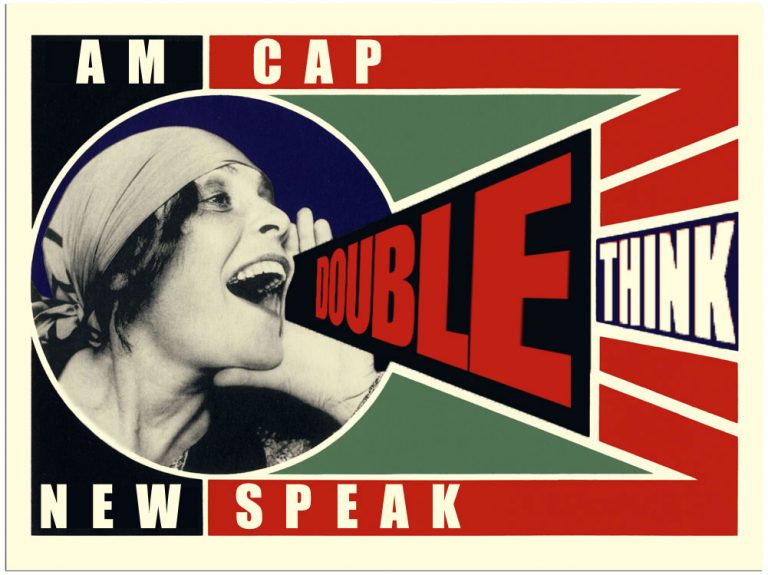
The use of Newspeak is now so widespread that every informed reader (and writer) must be conversant in it. As a public service, the editors of the Apocalypse Review have decided to publish an excerpt from our Am Cap (American Capitalist) Newspeak Glossary. Additions and edits are welcome.
Trickle-down. An approach to social welfare in which the social safety net is replaced by tips. Please see Billionaires pledge to tip better.
Free-market economy A modern rethinking of feudalism in which the manor house is replaced by the corporate campus, the nobility by a Board of Directors and the demesne by intellectual property monopolies. In a “free market” polity, the merchant class runs the economy, which leads to increased wealth because of accurate price discovery and the efficient allocation of resources. Unfortunately, merchants are no fun at parties, would rather pay you with tips, and couldn’t care less about social security. As a result, most “free-market” economies are characterized by income inequality and an absence of services for the poor, aged, unlucky and infirm. In “free-market economies” all law is torte-based, and the role of government is limited to muzzling dissent, garnishing wages, imprisonment and the periodic engagement in resource-based wars. In the “free-market economy” justice is meted out by a type of bailiff known as a company-appointed arbiter.
Spin. Contextual lying related to an event, situation or idea, not facts. Example of usage: The Governor of Florida forced country medical examiners to not publish Coronavirus death figures so that he could spin the situation in a way that was acceptable to his political masters.
No Malarky. In most English dialects malarky is a synonym for bunk. In Newspeak opposition to malarky is a type of malarky that eschews malarky. Many moderates are defined as such exclusively because of their opposition to malarky.
Woke. An epithet applied to any phrase in which sensitivity is applied to discussions about race, religion, gender, ethnicity and/or sexual orientation. As is common in Newspeak, the phrase is used in a manner opposite to its traditional English meaning, in this case as a way of discouraging polite discourse. Synonymous with politically correct.
Politically Incorrect. A phrase that celebrates racist, sexist, homophobic and/or other insensitive language. Example of usage: Because the joke was based on politically incorrect, racist stereotypes, the man wearing a MAGA hat laughed uproariously.
Venezuala. Failed state. Example of usage: The United States under President Trump is the Venezuala of Capitalism.
Laffer Curve. A graph of taxation income elasticity that claims to demonstrate how lowering taxes increases tax revenue. It was first graphed by Arthur Laffer in 1974 on a back of a napkin, during a meeting with Dick Cheney and Donald Rumsfeld. Since that time, the Laffer Curve has been used by conservatives to justify any fiscally irresponsible policy formulated on the back of a napkin, most notably the 2012 Kansas state budget and the so-called “Big Beautiful Bill”.
Laffer is widely praised for his work by conservatives, who credit him with doing more to turn economics into a non-empirical discipline than any other economist.
Historical note: Treasury Secretary and robber baron Andrew Mellon in his first budget under President – and notorious tight-wad – Calvin Coolidge attempted to raise revenue by cutting taxes on plutocrats. It was sufficiently unsuccessful that it became a template for future Republican budgets.
Choice in Health Care. A phrase used by health insurance industry lobbyists, which refers to any practice that restricts access to doctors, hospitals or medical services. The American Health Care Act of 2017 and the Big Beautiful Bill of 2025 are prime examples of the promotion of “choice” in health care. These pieces of legislation withdrew federal funding from rural clinics; allowed private hospital corporations to create regional monopolies; and promoted fee-for-no-service health insurance plans. It important to note that the ability of citizens in Western Europe and Canada to go to any doctor or hospital without penalty is not an example of “choice” in health care. Such freedom of choice is referred to in Newspeak as socialism.
Moral hazard. In economics a moral hazard is any policy that creates an incentive for actors to take on an unacceptable level of risk, typically by externalizing it. In the AmCap (American Capitalist) dialect of Newspeak this definition is more narrowly applied to policies that alleviate the economic condition of citizens who are not wealthy (see socialism, above). Example of usage: By separating health care coverage from employment, the public option creates a moral hazard by allowing employees to leave jobs they hate without fearing the loss of health insurance coverage. Note that in the AmCap dialect of Newspeak the phrase moral hazard can never be applied to the activities of corporations. Statements such as the following have no meaning: By guaranteeing insurance company profits, the Affordable Care Act created a moral hazard by eliminating all incentives for insurance companies to control costs.
Pro-life. A policy that promotes life from conception to birth, but not beyond. Example of usage: By cutting off funding to rural clinics whose views on birth control he opposes, Texas Governor Gregory Wayne Abbott ensured not only that more babies would be born, but that more mothers would die while giving birth.
Please see: Race to the Bottom Won Example of usage: Despite having by far the worst child-birth outcomes in the western world, pro-life Texas Republicans redirected health care spending to private health care firms.
Family values (1) Any set of policies that uses children as an excuse to promote tax cuts for everyone but the poor, for example the The Child Tax Credit Act. (2) A policy framework which discriminates against citizens based on their sexual orientation. Example of usage: The family values promoting Republican Senator was so excited to vote against extending legal protection to the LGBTQ community that he solicited sex in the airport rest-room.
Free-trade. A trade regime that strengthens intellectual property monopolies and/or undermines environmental and labor regulations. Example of usage: The Trans-Pacific Partnership free-trade agreement was widely hailed by moderate Democrats and conservative Republicans alike because it increased the duration of patent monopolies while gutting the ability of governments to regulate polluting industries. The Newspeak use of the phrase free-trade should not be confused with the archaic use of the term found in 19th and 20th century texts, such as “On the Principles of Political Economy and Taxation” by David Ricardo.
Deregulation. Any policy that increases the ability of corporations to externalize costs and / or reduce safety standards. Example of usage: As a result of successful deregulation, chemical factories situated on the Texas Gulf Coast explode on a regular basis.
Tax relief. Tax cuts for billionaires.
Tax on Someone Else. First mooted by Canadian Economist Stephen Leacock, the “tax on someone else” is a policy goal promoted by fiscally responsible moderates and progressives alike. The tax promotes virtuous policies while always being levied on someone other than the person who benefits from said policies.
Common Sense. A type of policy (as well as the moral sensibility associated with that policy) that seeks to undermine public education, public health and/or the tax base. Common sense policies rely heavily on the work of Arthur Laffer (see Laffer Curve). Example of usage: The Premier of Ontario’s Common Sense Revolution in 1990 undid two generations of fiscal probity on the part of Ontario’s Progressive Conservative Party. Public finances in Ontario have yet to recover.
Outsourcing. Rent-seeking.See Public-Private partnership.
Co-pays and Deductibles. A surcharge on health services levied by health insurers to counter the moral hazard posed by universal health care coverage. Example of usage: Deductibles on Bronze plans grew by 15% a year between 2016 – 2019. Please see – USCIS Announces Bronze Citizenship
Privatization. (1) A type of looting where the role of barbarian hordes is filled by management consultants wearing high thread-count suits. (2) Any policy that allows private sector actors to profit from the erosion of the quality of public services, typically at the expense of tax payers.
Examples include: the privatization of Chicago’s parking meters; the privatization of water in Chile; and the privatization of pension plans in New Jersey and Florida, by Republican Governors Chris Christie and Jeb Bush.
Good, well-paying Job. Any job in the United States that pays up to 1/2 the Danish minimum wage (but no more). Not to be confused with a good job.
Well-paying job. Any employment that pays either minimum wage or is based on tips or commission. Example of usage: The White House today affirmed that unemployment had reached a record low because the private sector has been creating an abundance of well-paying jobs in retail.Well-paying jobs are considered more stable than good well-paying jobs because they are less likely to be automated.. Please see https://www.jobqualityindex.com
Public-private partnership. An approach to governance in which profits from the provision of government services are privatized while costs are paid for by taxpayers. Public-private partnerships are similar to privatized government programs with the exception that in former instance the cost of risk is a priori borne by the public sector, whereas in the latter it is transferred to the public sector as a result of poorly negotiated contracts.
Market-based solution. Any policy that replaces government services with those provided by companies controlled by political donors.
Blue Lives Matter A euphemistic way of saying that Black lives don’t matter.
Meritocracy. A kakistocratic system of governance in which the civil service is staffed based on race, family connections or attendance at an Ivy league school. Example of usage: Although Supreme Court Justices in the United States are chosen based on merit, they must have a law degree from either Harvard or Yale.
Free-speech. Money. The wealthier an individual is, the freer their speech.
The equivalence of money and free-speech is not exact in Newspeak, however, and should only be applied to billionaires and corporations, and not to the hoi polloi. This distinction is succinctly illustrated in the Supreme Court Case Arizona Free Enterprise v. Bennett. The majority opinion in this case, written entirely in Newspeak by Justice John Roberts, eloquently argues that campaign financing for underfunded political candidates is not free speech, and in fact violates the First Amendment right of billionaires to use money to purchase elections.
Freedom. (1) The right of plutocrats to do whatever they want. (2) Shopping. When the word freedom is applied to non-billionaires it typically refers to freedom of choice, for example the freedom to purchase an inexpensive “fee-for-no-service” health insurance plan. The AmCap-Newspeak word freedom should not be confused with its English cognate freedom, which – as used in the Constitution and the Bill of Rights – refers to one’s ability to engage in unfettered action within a lawful state
Second Amendment Rights / The Right to Bear Arms. The right of all white people, including sociopaths, psychopaths, villains and the insane to purchase any weapon up to and including military hardware. This concept can be particularly confusing to novice students of Newspeak because it bears only a tangential relation to Second Amendment support of a “well regulated militia”. What this underscores is that Newspeak isn’t just about i) presenting an idea as its opposite, ii) excluding unwanted ideas from discourse, iii) replacing precision with ambiguity and iv) using gas-lighting to redirect blame. Newspeak is also a powerful tool for presenting extreme positions as normal.
Conservatism. A type of fascist ideology in which the interests of church, state and business are considered to be identical. Individuals, with the exception of aristocrats, plutocrats and Monarchs, are of secondary importance. Conservatives support deficit financing, oppose the Establishment Clause of the Constitution, seek to remove all business taxes and argue that the Second Amendment support of “A well regulated militia” entitles insane white men to buy machine guns. The use of conservative in Newspeak should not be confused with its archaic use, which describes those who support fiscal probity, competitive markets and the separation of church and state. Example of usage: The first piece of legislation passed by conservatives in the 115th session of Congress removed mental health restrictions on the purchase of assault weapons.
Moderate. A moderate is a type of conservative whose views fall short of fascist. Moderates can be identified by their extreme aversion to substantive change; moderate politics are characterized by capitulation and inaction. The favored social policy of moderates is welfare reform; their favorite policy tool is the tax credit and their typical excuse for inaction is that “The People are not ready”. Moderates always support increases to the military budget and oppose universal healthcare coverage because it creates an unaffordable moral hazard. Moderates are always careful not to offend the billionaires who fund them. Example of usage: The moderate Democrat Senator Charles Schumer voted against the repeal of the carried interest tax loophole because the American people were not ready for hedge fund billionaires to have the same marginal tax rate as their secretaries. Please see Schumer Supports Billionaires
Qualified Immunity. A policy which gives unqualified immunity to all activities engaged in by Police officers, particularly vandalism and theft. Example of usage: Officer McClendon was unconcerned about the consequences of destroying the Black American man’s Mercedes because he was protected by qualified immunity. (Source. Second Source).
Extra virgin. The culinary opposite of “sort of pregnant”. Example of usage: Extra-virgin olive oil.
Welfare reform. Any set of policies designed to ensure that the United States has a weak social safety net. Example of usage: As a result of work requirements included in the 1996 welfare reforms signed into law by moderate Democrat Bill Clinton, single mothers in Milwaukee were forced to take 2 hour bus rides to minimum wage jobs.
Reaching Across the Aisle. A political process in which both conservative and moderate politicians agree to pay for increases in military spending through cuts to social programs. The phrase is also sometimes used to describe agreements in which intellectual property monopolies are bolstered or the interests of the fossil fuel industry are served. Example of usage: Moderates in the House reached across the aisle to conservatives in the Senate to draft an interim budget. The agreement increased military spending by $84 billion while imposing work requirements for disability related welfare payments. Source
Fiscally Responsible Fiscally irresponsible. Example of usage: In the last years of the 1990s Governor Pataki of New York replaced MTA property tax revenue with debt because it was the fiscally responsible thing to do, given low interest rates. Wall Street donors to the Governor are estimated to have received over $85 million dollars in fees for this service. Source
No Change Since 1998. 1998 was an outlier, in terms of global temperature. As such conservatives like to use it as a baseline when promoting the claim that carbon dioxide is not a green house gas, typically beginning their arguments with the phrase since 1998 there has been NO change in global temperatures. Example: Senator Ted Cruz gives a master class in baseline manipulation.
Please send your examples to editor@apocalypsereview.com with the subject Newspeak.